## Introduction
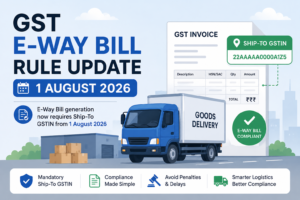
If your business generates e-way bills, tomorrow’s date matters. From **1 August 2026**, the GST Network is making a field that used to be optional — the Ship-To GSTIN — compulsory for a large chunk of everyday transactions. This isn’t a small tweak buried in a technical circular. It affects how goods move from head offices to branches, how retailers dropship to customers, and how third-party logistics arrangements get reported. Get it wrong, and your e-way bill can either fail to generate or expose you to detention and penalty proceedings if tax officers spot a mismatch.
This guide breaks down exactly what changed, why the rollout was delayed twice, who is affected, and a practical checklist you can run through before the rule goes live.
## 1. What Changed and Why It Matters Right Now
Until now, the Ship-To GSTIN field on the e-way bill portal was optional in practice, even in cases where the billing party and the delivery location were clearly different entities. GSTN has now made this field mandatory whenever Ship-To details are present in a Bill-To/Ship-To transaction, based on its advisory issued in May 2026 and further specifications released in June 2026.
In plain terms: if your invoice is billed to one GSTIN but the goods physically go to a different GSTIN-holder, that receiving GSTIN now has to be captured accurately on the e-way bill — not left blank or filled loosely.
## 2. Timeline: How This Rule Got Delayed Twice
| Date | Development |
|—|—|
| 20-21 May 2026 | GSTN issues advisory introducing mandatory Ship-To GSTIN capture and voluntary e-way bill closure, originally effective from 15 June 2026 |
| 9 June 2026 | Industry bodies, ERP vendors, and GST Suvidha Providers request more time for system changes; GSTN defers the effective date to 1 August 2026 |
| 17 June 2026 | GSTN releases detailed API-level specifications covering the e-Invoice API, e-Way Bill by IRN API, and new EWB Closure API, opened for sandbox testing |
| 1 August 2026 | Production rollout — rule becomes live |
Industry associations had pushed back mainly on three grounds: ERP and customer master databases needed updating across thousands of delivery locations, commercial confidentiality concerns around sharing GSTIN details in multi-party transactions, and a general request for a longer transition window before enforcement began.
## 3. What Exactly Is the Ship-To GSTIN Requirement?
A Bill-To/Ship-To transaction happens whenever the party being billed is different from the party physically receiving the goods. The portal has always supported this transaction type — the change is that the Ship-To GSTIN field, which businesses could previously leave blank or fill inconsistently, now has to be populated correctly.
Key rules to know:
– If the ship-to party is GST-registered, their GSTIN must be entered.
– If the ship-to party is unregistered, the field should carry the value **”URP”**.
– Bill-To and Ship-To cannot carry the same GSTIN — GSTN treats this as an invalid Bill-To/Ship-To transaction and will reject it.
– If goods move to the buyer’s own additional place of business under the *same* GSTIN, it isn’t treated as a Bill-To/Ship-To case at all — it should be reported as a regular supply with the actual delivery address.
– Once Ship-To details are entered at the e-Invoice (IRN) stage, they cannot be changed later while generating the e-way bill, so accuracy at the invoicing stage matters.
– The Ship-To GSTIN itself will not be printed on the e-way bill and won’t appear through the standard e-way bill retrieval API — it stays visible only to tax officers during verification.
## 4. Who This Rule Applies To
This affects a wider set of businesses than it might first appear:
| Business Model | How It’s Affected |
|—|—|
| Head office procurement, branch delivery | Goods billed to HO but delivered to a branch/depot/warehouse under a different GSTIN now need that GSTIN captured |
| Retail dropshipping | When a retailer invoices a customer but instructs a wholesaler/manufacturer to ship directly, the actual receiving party’s GSTIN (or URP) is required |
| Multi-location GST registrations | Companies with several GSTINs across states need their e-way bill software to pull the correct GSTIN per delivery point |
| Third-party logistics / job work | Where goods route through an intermediary before reaching the final consignee, the ship-to detail needs to reflect the true delivery point |
| B2B and SEZ transactions | Ship-to details captured at the IRN/e-invoice stage carry forward and cannot be overridden at e-way bill generation |
## 5. What Happens If You Get It Wrong
Two risks stand out:
1. **Generation failure** — Missing or invalid Ship-To GSTIN data in a case where it’s required can simply stop the e-way bill from being generated, halting dispatch.
2. **Detention and penalty exposure** — If an e-way bill does get generated but the invoice and e-way bill details don’t align, it can invite scrutiny under **Sections 129 and 130 of the CGST Act, 2017**, which cover detention, seizure, and release of goods and conveyances found in transit with defective documentation, along with the associated penalties.
Given both risks sit on the operational side (dispatch delays) and the compliance side (penalty exposure), this is worth treating as a priority system update rather than a minor form field.
## 6. The New E-Way Bill Closure Facility
Alongside the Ship-To GSTIN mandate, GSTN has also introduced a **voluntary** e-way bill closure facility, effective the same day. Once goods are delivered, the supplier, recipient, transporter, or driver can formally close the e-way bill — on the day of delivery or the next day — rather than letting it simply expire based on its original validity period.
This is optional for now, but it builds a delivery-confirmation layer into the GST system. Businesses that build the habit of closing e-way bills early will have cleaner audit trails, which is useful in itself and may matter more if closure becomes mandatory down the line, as several tax practitioners are anticipating.
## 7. Step-by-Step: How to Stay Compliant
1. **Audit your customer and delivery-location master data.** Every recurring delivery point needs a correct GSTIN (or URP) mapped against it.
2. **Talk to your ERP/billing software vendor.** Most major providers have already released updates supporting the new Ship-To GSTIN field — confirm your version is current.
3. **Fix data entry at the invoicing stage.** Since Ship-To details entered at IRN generation carry over and can’t be edited later, train billing staff to get it right the first time.
4. **Test in the sandbox if you’re an API/ERP integrator.** GSTN opened its sandbox environment ahead of the 1 August go-live specifically for this purpose.
5. **Decide who owns e-way bill closure internally.** Even though it’s voluntary, assign responsibility (dispatch team, transporter, or recipient) so delivery confirmation doesn’t fall through the cracks.
6. **Brief your transport and warehouse teams.** Frontline staff handling dispatch need to know that incomplete Ship-To data can now block e-way bill generation altogether.
## 8. Comparison: Before vs After 1 August 2026
| Aspect | Before 1 August 2026 | From 1 August 2026 |
|—|—|—|
| Ship-To GSTIN field | Optional | Mandatory where Ship-To details apply |
| Bill-To = Ship-To (same GSTIN) | Allowed in practice | Rejected as invalid |
| Unregistered consignee | Inconsistent handling | Must use “URP” |
| E-way bill closure | Not available | Voluntary closure facility introduced |
| Mismatch risk | Lower enforcement focus | Can trigger Section 129/130 scrutiny |
## Conclusion
The Ship-To GSTIN mandate is a small field-level change with a real operational footprint, especially for businesses running multi-location dispatch, dropshipping, or third-party logistics models. GSTN has already used its one deferral, pushing the date from 15 June to 1 August 2026, and detailed API specifications have been in sandbox testing since mid-June — so a further postponement looks unlikely. The safest move is to treat 1 August as fixed, get delivery-location GSTIN data cleaned up now, and start using the voluntary closure facility early to build good compliance habits before it potentially becomes mandatory.
**Use our free GST Calculator to check your GST liability, or explore our GST Late Fee Calculator to stay on top of compliance deadlines.**